Where the calendar on the wall came from
The civil calendar has an untidy past of its own. The early Roman version ran to ten months and opened the year in March, and the wreckage of that numbering is still hanging on the wall: September, October, November and December are Latin for seventh, eighth, ninth and tenth, names that stayed put after the months shifted two places along.
Julius Caesar sorted it out in 46 BCE. To absorb the drift that had piled up, the year before the reform was stretched to 445 days, and was fairly called the year of confusion. From then on: 365 days, with one more every fourth year.
It was very nearly right. The Julian year runs about eleven minutes longer than the truth, which is nothing at all until you wait long enough: after 128 years those minutes make a full day, and by the sixteenth century the error stood at ten. In 1582 Pope Gregory XIII cut the knot: the day after 4 October was declared 15 October, and ten dates simply never happened. A sharper leap-year rule came with it. Every fourth year still takes an extra day, except in a century year, and even that exception is waived when the century divides by 400, which is why 2000 kept its 29 February and 1900 did not.
The rest of the world was in no hurry. Britain changed over only in 1752 and Russia only in 1918, which is why the October Revolution happened, by the calendar printed here, in November.
Why the Hebrew date beside each day keeps sliding
The two dates in each cell do not travel together. A birthday kept on 14 May will still be 14 May in ten years; a yahrzeit on the 17th of Tammuz moves across the civil calendar from one year to the next.
The reason is simple enough. Twelve lunar months come to about 354 days, eleven short of a solar year, so every Hebrew date arrives about eleven days earlier on the civil calendar than it did last year, and after a leap year, which adds a whole thirteenth month, it falls back by about nineteen. That is why Rosh Hashanah can open in early September or wait until October, and why Chanukah sometimes lands in late November and sometimes at the end of December. Nothing has actually moved; it is being measured with two rulers.
The extra month comes round seven times in every nineteen years, and it has one job: to keep Passover in the spring. The other side of that story, how a Hebrew month is built, where its names came from, and how the beginning of a month was once decided, is on the Hebrew month calendar.
A printed month on the wall
Most digital tools show you a week, or a list. A whole month on one sheet does something else: it puts a complete unit of work in front of you at once, which is about as far ahead as a commitment you gave a client is still accurate and still changeable.
The difference shows the moment you draw the first bar. A week that looked full turns out to be three working days once you see a coloured festival sitting in it. Two deliveries that landed in the same week catch your eye before they become a problem. A heavy month following a quiet one stops being a surprise. And because the Hebrew date sits beside the civil one, events set by the Hebrew calendar are on the same sheet as everything else, with no cross-referencing between two calendars.
For a longer horizon, the ten-week Gantt chart lays a full quarter out on one page on the same principle.
Common questions
How do I print it?
The button above the calendar opens the print dialog with the month alone (no navigation, none of this text) and lets you choose portrait or landscape. In the same dialog you can pick "Save as PDF" instead of a printer.
Does the calendar show Hebrew dates and the festivals?
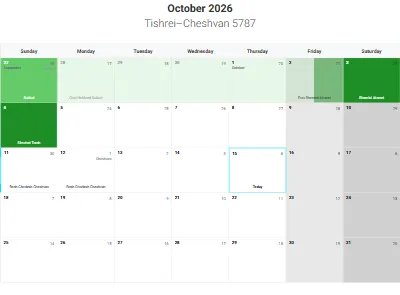
Yes. Both dates sit side by side in every cell, Shabbat and the festivals are coloured in already, and Rosh Chodesh is marked at the edge of the cell.
How far ahead can I print?
Three years. The list below rolls forward on its own each year.
What is the difference between this and the Hebrew month calendar?
These pages follow the civil month, first to last, with the Hebrew date alongside each day. The Hebrew month calendar inverts that: the month opens on Rosh Chodesh and closes at the month's end, and the civil date is the one riding along.
Do I need to register?
No. There is no sign-up and no charge: you pick a month and print it.
The month on paper
A whole year on one sheet has to shrink every cell until there is no room to write in it. A page per month does the opposite: the month gets the whole sheet, the cells are large enough to write in by hand, and the Hebrew date stays legible beside the civil one.
- The same days, ordered by the Hebrew month: Hebrew month calendar
- Every festival of the year in one table: Jewish holidays 2026
- The full printable calendar: printable 2026 Jewish calendar with holidays