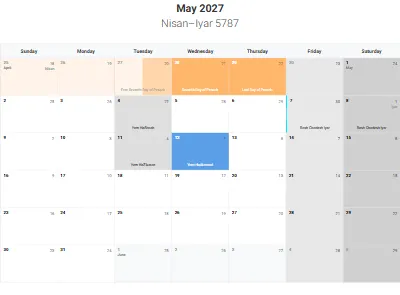
May is the month the Israeli summer begins in without anyone announcing it: the rain stops, the sea warms up, and the evenings stretch past seven. On the Hebrew calendar it usually covers Iyar and the start of Sivan, and it carries Lag BaOmer and, in about half of years, Memorial Day and Independence Day too.
Maia, goddess of growth, or simply the elders
May comes from Maius, and the usual explanation ties it to Maia, an old Italic goddess of growth, increase and abundance. Her own name sits close to the Latin root behind words for great and for growing, so the month carries in its name what is happening in the fields during it.
The Roman poet Ovid, who wrote an entire book on the origins of the calendar, offers a second and stranger explanation: that the month took its name from the maiores, the elders, and June from the iuniores, the young: two neighbouring months dividing the ages of Roman society between them. Ovid declined to choose between the explanations, and historians today have not chosen either.
May around the world
The first of May carries two layers that have nothing to do with each other. The older one is the European spring festival: Celtic Beltane and the maypole that children still dance around in villages in England and Scandinavia. The newer one is International Workers' Day, fixed to that date in 1889 in memory of the Haymarket affair in Chicago in 1886, and now a day of strikes and marches across much of the world.
The eighth and ninth of May are the days of victory over Nazi Germany. The gap between the two dates is a matter of clocks: the instrument of surrender was signed overnight, and in Moscow it was already the next day, so western Europe marks the eighth and eastern Europe the ninth.
And across much of the world, from the United States to Japan, the second Sunday in May is Mother's Day. In Israel that custom turned into Family Day, which is kept on 30 Shevat instead.
What May weather is like in Israel
May is summer in everything but name. The rain has all but finished and the sky is clear almost every day.
Tel Aviv typically runs between about 18°C and 27°C, Jerusalem between roughly 15°C and 26°C, and Eilat between 25°C and 37°C. The sea is already around 22–23°C and the swimming season opens in earnest. Humidity on the coast starts to climb, but the evenings are still pleasant and the hills are still cool at night.
The sharav pays its last visits too: isolated days of easterly wind that push the valleys past 40°C and dry the scrub out completely. Which is exactly why May also opens the fire season, with restrictions on open-air bonfires in the countryside.
Jewish dates that fall in May
May usually spans Iyar and the start of Sivan, and every day of it sits inside the counting of the Omer, the forty-nine days between Passover and Shavuot:
- Yom HaZikaron and Yom HaAtzmaut: 4 and 5 Iyar. In about half of years they fall in May and in the rest in April.
- Lag BaOmer: 18 Iyar, the day the mourning customs of the Omer stop: a night of bonfires the length of the country and a mass gathering at Meron. It falls between late April and late May, and in most years here.
- Jerusalem Day: 28 Iyar, marking the reunification of the city in the Six-Day War. It lands in May or early June.
- Shavuot: 6 Sivan, closing the count. It falls between mid-May and mid-June, and in early years it is already here.
Every date of the year in one table: the annual holidays calendar.
Common questions about May
When is Rosh Chodesh in May?
Most years May carries Rosh Chodesh Sivan, a single day, because Iyar always has twenty-nine. In early years Rosh Chodesh Iyar turns up at the start of May instead, and that one runs for two days. This year: Rosh Chodesh Iyar: 7-8/5/27.
Which Hebrew months does May cover?
Usually Iyar and the beginning of Sivan. Every cell in the grid above carries both dates.
How many days are in May?
Thirty-one.
When is Lag BaOmer?
On 18 Iyar, between late April and late May, and in most years in May, this year on 25/5/27. The Lag BaOmer page has the exact date.
Is anything a day off in May?
Independence Day, in years when it falls in this month. Lag BaOmer and Jerusalem Day are working days, though neither looks much like one in a school.
Printing a May calendar
The grid at the top of this page shows May whole, from the 1st to the 31st: the civil date and the matching Hebrew date in every cell, the Sabbaths and their Torah portions, and every festival falling in the month, the days of the Omer and Lag BaOmer included. The button above the grid prints it to a single page, portrait or landscape.
- Every date of the year with its own page: the annual holidays calendar
- The full printable year: home page
- For a Hebrew-month view, in which Iyar and Sivan each appear whole: Hebrew month calendar