July is the month the Israeli year comes to a halt in. Schools are shut, the Hebrew calendar has almost nothing marked in it, and the whole day arranges itself around the heat: out early, still at midday, waiting for the sea breeze that arrives in the afternoon.
It is also one of only two months in the calendar named after a person rather than a god or a rite: for the first few centuries of its life it was simply called "the fifth". On the Hebrew calendar July covers Tammuz and Av, and it holds the fast of 17 Tammuz and the opening of the Three Weeks, and in some years Tisha B'Av itself.
Where the name comes from: Julius Caesar's month
In the old Roman calendar the year began in March, which made this the fifth month. So they called it exactly that: Quintilis, "the fifth".
In 44 BCE, the year Julius Caesar was assassinated, Rome renamed it Iulius after him, the month he had been born in. It was the first time a Roman month carried a person's name instead of a god's, and it was not an empty gesture. Two years earlier Caesar had rebuilt the Roman calendar from the ground up: he fixed the year at 365 and a quarter days, added a day once every four years, and cut the months loose from the moon altogether. That Julian calendar ran Europe for some fifteen centuries, until the Gregorian reform of the 16th century replaced it. Of everything that was named for Caesar, what survived is the summer month he was born in.
The season in Israel: high summer, and not a drop of rain
It does not rain in Israel in July. Not "hardly ever". It simply does not. A July drizzle is the kind of freak event people still bring up years later.
On the coastal plain the day reaches 30–31°C, but the number is misleading: humidity sits at 65–75%, which makes the same heat feel far heavier. The night barely cools, and Tel Aviv is still around 25°C in the small hours. Jerusalem and the hills get similar daytime figures with dry air, and drop to 19–20°C after dark; the Jordan Valley, the Dead Sea and Eilat pass 38°C routinely and sometimes 42°C. The sea reaches about 28°C and stops being refreshing.
The longest day is already behind us (it falls on 21 June) but July shortens at roughly a minute a day, which nobody can feel.
July around the world
July is a month of big national holidays. It opens with Canada Day on the 1st, holds American Independence Day on the 4th with its fireworks and barbecues, and on the 14th France marks Bastille Day: the storming of the Paris prison in 1789. In Spain, from the 6th to the 14th, Pamplona closes its streets and runs bulls through them for the festival of San Fermín.
In Japan, on 7 July, comes Tanabata: a wish is written on a narrow strip of paper and hung on a bamboo branch, in memory of two stars that legend allows to meet for one night a year.
Even the phrase "the dog days" was born here. The Romans called the hottest weeks of summer dies caniculares, because Sirius, the Dog Star, rises with the sun in this season; the French word for a heatwave, canicule, comes from the same root.
The Hebrew dates that fall in July
In most years July holds no festival at all. What it does hold are two heavy marks on the calendar:
17 Tammuz: a single-day fast, from dawn to nightfall, falling somewhere between late June and late July. It opens the Three Weeks known as bein hametzarim, during which certain mourning customs are kept.
Tisha B'Av: the Jewish people's national day of mourning and, with Yom Kippur, one of the two full-length fasts of the year. It drifts between mid-July and mid-August, and in the earlier years it lands in July. The full account is on the Tisha B'Av page.
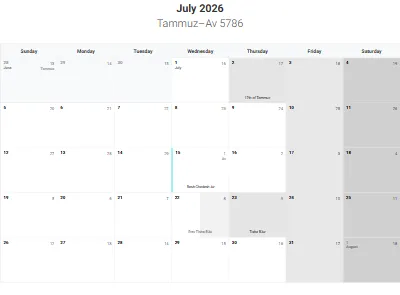
In the grid at the top of this page the large numerals are the civil dates, with the Hebrew date printed beneath each one, so you can see at a glance which weekday every Hebrew date in July falls on. The button above the grid prints the month to a single page, portrait or landscape, without the navigation or this text. For every date in the year at once there is the annual holiday calendar, and for the current month, the home page.
Common questions about July
How many days are in July?
Thirty-one. July and August are the only two consecutive months in the civil calendar that both have 31 days.
Which Hebrew months fall in July?
Tammuz and Av, plus the tail of Sivan in years when the Hebrew calendar runs late. The Hebrew date of 1 July shifts by about eleven days each year, because the Hebrew year is shorter than the civil one.
Is there a Jewish festival in July?
No festival. What there is: the fast of 17 Tammuz, falling this year on 2/7/26, and the start of the Three Weeks, and in early years Tisha B'Av as well, falling on 23/7/26.
Why is the month called July?
After Julius Caesar, who was born in it. Until 44 BCE it was Quintilis, "the fifth", after its place in a Roman year that began in March.
When does the Israeli summer holiday start?
On 1 July for primary schools. Middle and high schools finish earlier, on 20 June.