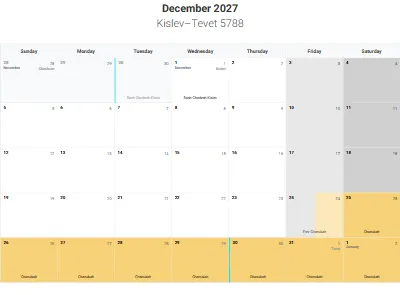
December is the month in which both calendars finish at nearly the same time. The civil year ends in it, and in almost every year Hanukkah falls inside it too, in whole or in part, so the eighth candle and the last page of the calendar usually arrive within the same fortnight.
These are also the shortest days of the year, and December is the wettest month alongside January. There is something fitting in that: of all twelve months, the one with the longest dark is the only one whose festival is defined by a lamp.
Where the name comes from: the month that proves Rome did not count winter
December comes from decem, ten. It is the last of the four numbered months and the most conspicuous of them: the "tenth" month sitting in twelfth place.
That is the clearest evidence that the Roman year once began in March. But there is something stranger still behind it. By Roman tradition, Rome's earliest calendar had only ten months and about 304 days, and it ended in December. The winter that followed was simply not counted: a stretch of time with no name and no months, waiting for spring to set the year moving again. Only later, the same tradition says, were January and February added to fill that gap.
So the name December is not an error nobody got round to fixing. It is a survival from a time when the year ended right here, and everything after it was not worth numbering.
The season in Israel: the shortest and wettest days
December and January are the wettest months of the year. The coastal plain takes about 130 millimetres in December, usually in a handful of storms rather than as continuous drizzle, and between the storms there are days that are clear and entirely pleasant.
The coast runs at 18–19°C by day and about 10°C at night; Jerusalem at 13–14°C by day and 6–7°C at night, colder still on the sharpest nights. Snow falls reliably only on Mount Hermon; in Jerusalem it is a once-in-a-few-years event.
The shortest day falls on 21 or 22 December, and in Israel it holds only about ten hours of daylight. But here is the surprising part: the earliest sunset does not land on the shortest day. It comes about two weeks earlier, at the start of December, while the latest sunrise only arrives in early January. The evenings, in other words, start getting longer before the shortest day has even happened.
December around the world
Almost every December custom in the world grew around the same point: the shortest day, and the moment the light begins to come back.
In Rome, from the 17th to the 23rd, came the Saturnalia: a week of feasting and reversed roles in which masters served their slaves at table, schools closed, and gifts were exchanged, candles among them. Late Rome marked Sol Invictus, "the unconquered sun", on 25 December, and Christmas eventually settled on the same date. In Sweden, on 13 December, comes St Lucy's Day: a girl in a white dress with a crown of candles on her head opens the dark morning with singing.
In Israel the last evening of the civil year is called Sylvester, after Pope Sylvester I, whose feast day falls on 31 December, a Central European usage that arrived with immigrants and stayed in spoken Hebrew.
The Jewish festivals and fasts that fall in December
December covers Kislev and Tevet, and holds the most domestic festival in the calendar:
Hanukkah: eight days beginning on 25 Kislev. On the civil calendar that date drifts between 28 November and 27 December, so in most years the whole festival sits inside December, while in others it opens at the end of November or spills into early January. Hanukkah page.
Rosh Chodesh Tevet: falls during Hanukkah itself, so the last and fullest candles are already being lit in Tevet.
Asara B'Tevet: a short one-day fast marking the start of the siege of Jerusalem before the destruction of the First Temple. It drifts between mid-December and mid-January.
There is an overlap here worth noticing: the one Jewish festival made entirely of light and the end of the civil year almost always arrive in the same fortnight, and the school Hanukkah holiday sits inside it too. The grid at the top of this page shows how December splits between Kislev and Tevet in the year selected, and the button above it prints the month to a single page. For the full list there is the annual holiday calendar; for the current month, the home page.
Common questions about December
How many days are in December?
Thirty-one, the last of the civil year.
Which Hebrew months fall in December?
Kislev and Tevet. The border between them falls inside Hanukkah, at Rosh Chodesh Tevet.
Is Hanukkah always in December?
Almost always, but not always in full. 25 Kislev drifts between 28 November and 27 December, so some years the festival opens in late November and others its final days are already in January. This year it opens on 25/12/27.
When is the shortest day of the year?
On 21 or 22 December, holding about ten hours of daylight in Israel. The earliest sunset comes about two weeks before it, at the start of the month.
Why is December called that if it is the twelfth month?
The name comes from decem, ten. By Roman tradition Rome's earliest calendar had only ten months and ended in December; January and February were added later at the front of the year, and the numbered names stayed as they were.