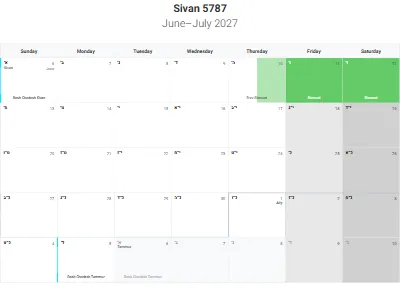
Sivan is the month the counting ends in. The forty-nine days that began at Passover run out on its fifth day, and the next day, the sixth of Sivan, is Shavuot, one day in the Land of Israel and two in the Diaspora.
And that is very nearly all of it. After the first week come twenty-three consecutive days without a single marked date, the heat starts to stack up, and in Israel the school year winds down. Sivan therefore has an unusual shape: it opens at its peak and then subsides slowly into summer.
The third month
The Torah gives this month no name. It is "the third month", and that is how it appears in the sentence opening the largest scene in the Bible: "On the third new moon after the Israelites had gone forth from the land of Egypt, on that very day, they entered the wilderness of Sinai" 1. Seven weeks after leaving Egypt, in exactly this month, they reached the mountain.
The name Sivan came back from Babylon with the returning exiles, like every Hebrew month name in use today, and it turns up in the book of Esther, where, as with Nisan, the text still glosses it for the reader: "the third month, that is, the month of Sivan" 2. Modern Hebrew spells it two ways, סיון and סיוון; both are correct and both mean this month.
The days of Sivan, in order
Rosh Chodesh Sivan (1 Sivan). One day only, because Iyar is a deficient month. By the biblical account it is also the day Israel reached the wilderness of Sinai.
The three days of preparation (3–5 Sivan). The days before the giving of the Torah, when Israel was told to make itself ready and not approach the mountain. They have stayed in the calendar as three days of run-up to the festival.
The end of the Omer count (5 Sivan). The forty-ninth and final day of the count that started on 16 Nisan; by that evening the festival has already begun.
Shavuot (6 Sivan; 6–7 in the Diaspora). The festival of the giving of the Torah, and in the Bible also the festival of the harvest and of first fruits: the day the season's first produce was carried up to Jerusalem. It is the shortest festival in the calendar.
Isru Chag (7 Sivan in Israel). The day after the festival, kept by tradition as a light extension of it.
And from there Sivan has no further dates at all: twenty-three unmarked days in a row, until Rosh Chodesh Tammuz.
As one person, with one heart
The Torah describes the arrival at Sinai in a flat line: "Having journeyed from Rephidim, they entered the wilderness of Sinai and encamped in the wilderness. Israel encamped there in front of the mountain." Rashi stops on one word. The verse opens in the plural, they encamped, and then slips into the singular: he encamped. On that shift he writes four words that became a stock phrase in Hebrew: "as one person, with one heart", and adds: "but all their other encampments were made in a murmuring spirit and in a spirit of dissension" 3.
It is a remark about the camp, not about the mountain: every other stop in the wilderness was full of grievance and argument, and here, once, it was not. Immediately afterwards come the three days of waiting, "let them be ready for the third day" 4, which are still in the calendar.
So what tradition remembered about Sivan is not only what was said at the mountain, but what happened in the three days before it: a group of people who managed, briefly, to agree.
The one festival with no date
There is something odd about Shavuot that is easy to miss: the Torah never gives it a date. Every other festival gets a day of the month, the fifteenth, the tenth, the first, and here it gives only an instruction to count: "you must count until the day after the seventh week — fifty days; then you shall bring an offering of new grain to God" 5. The sixth of Sivan is the result of an arithmetic operation, not of an appointment.
Hence its rabbinic name, Atzeret, as though it were not an independent festival but the closing of something that began at Passover. And that is precisely the shape of the month. Sivan does not build towards a peak; it opens with one and then settles.
Something of that structure survives as a feeling. After Shavuot there is nothing left to count until Tishrei, the weather is fully summer, and in Israel the school year is running out. Sivan is where the Hebrew calendar changes down a gear.
Common questions about the month of Sivan
When is Rosh Chodesh Sivan?
On the 1st of Sivan, and it lasts a single day, because Iyar always has twenty-nine, and Rosh Chodesh runs for two days only when the preceding month is full. The civil date shifts every year (this year 6/6/27), as the grid above shows.
What month is Sivan?
The third month of the Hebrew calendar by the count that starts in Nisan, and the ninth by the count of years that starts in Tishrei. In civil terms it falls across May and June.
How many days are in Sivan?
Thirty, always. Its length is fixed and does not vary between a full and a deficient year, which is why Rosh Chodesh Tammuz, the month after, runs for two days.
What happens in the month of Sivan?
Rosh Chodesh on the 1st, the three days of preparation on the 3rd to the 5th, the end of the Omer count on the 5th, and Shavuot on the 6th (11-12/6/27, and the 7th in the Diaspora). Shavuot has its own page with dates and times. From the 8th onwards the month has no marked dates at all.
When does Sivan end?
On the 30th of Sivan, which is also the first day of Rosh Chodesh Tammuz (5-6/7/27).
A Sivan calendar: the whole month on one page
The grid at the top of this page shows Sivan as the Hebrew calendar sees it: the large numerals are the days of the Hebrew month, with the corresponding civil date printed beneath each one. You can see at once which civil date the 1st of Sivan falls on in the year selected, and what weekday the 6th lands on.
It is also the view that shows the month's shape: one crowded week, then three entirely open ones. You can see the Sabbaths and Torah portions read during the month, and the 30th of Sivan closing it and opening Rosh Chodesh Tammuz. The button above the grid prints it to a single page, portrait or landscape, without the navigation or this text.
- Every festival and fast of the year in one table, and from there the page for each one with its own dates: Jewish holidays 2026
- The full printable calendar: printable 2026 Jewish calendar with holidays
- For a civil-month view, in which May and June appear separately: Gregorian month calendar
Related pages
References
- Exodus פרק י"ט, פסוק א'
On the third new moon after the Israelites had gone forth from the land of Egypt, on that very day, they entered the wilderness of Sinai.
source - Esther פרק ח', פסוק ט'
In the third month, that is, the month of Sivan, on the twenty-third day of it.
source - Rashi on Exodus פרק י"ט, פסוק ב', ד"ה "ויחן שם ישראל"
"And Israel encamped there" — as one person, with one heart; but all their other encampments were made in a murmuring spirit and in a spirit of dissension.
source - Exodus פרק י"ט, פסוק י"א
Let them be ready for the third day; for on the third day God will come down, in the sight of all the people, on Mount Sinai.
source - Leviticus פרק כ"ג, פסוק ט"ז
You must count until the day after the seventh week — fifty days; then you shall bring an offering of new grain to God.
source