Elul is the twelfth and final month of the Hebrew year, twenty-nine days that end on the eve of Rosh Hashanah. It is the only month in the calendar with neither a festival nor a fast, and yet almost nothing about it is ordinary: preparation is its entire content. In modern Hebrew “Elul” has stopped being only the name of a month and become the name of a mood, late summer, stocktaking, and a shofar sounding in the morning.
A month born after a break
The Hebrew month names came back from Babylon with the returning exiles, Elul among them. But the character that stuck to this particular month rests on an older story: after the golden calf and the shattering of the first tablets, Moses climbed Sinai one last time. By tradition that third ascent began exactly on Rosh Chodesh Elul and lasted forty days, ending on Yom Kippur when he came down with the second set of tablets.
Pirkei DeRabbi Eliezer says that as Moses went up, a shofar was sounded through the camp so the people would not go astray again, and concludes: “therefore the sages instituted that the shofar should be sounded on Rosh Chodesh Elul every year” 1. The Tur took that and stretched it across the whole month: the shofar is blown each morning “to warn Israel to repent, and to confound the Satan” 2.
Which is to say: the month does not commemorate the break. It commemorates what happened afterwards: that it could be repaired.
“I am my beloved’s and my beloved is mine”
The Torah contains no commandment about Elul at all. Everything the month rests on is a single verse read as a hint. It comes from the Song of Songs: “I am my beloved’s and my beloved is mine, who browses among the lilies” 3.
The Mishnah Berurah spells out the reading: in Hebrew, the initial letters of the verse’s first four words spell *Elul*, and their final letters (four instances of the letter *yod*, worth ten apiece) add up to forty, matching the forty days from Rosh Chodesh Elul to Yom Kippur 4. He adds a second hint from an entirely different verse, “the Lord your God will circumcise your heart and the heart of your offspring”, whose initial letters also spell Elul 5.
None of this is proof, and it was never meant to be. It is a compact way of saying two things about the month: that it is about closeness, and that it assumes a closed heart can still be opened.
What people actually do in Elul
The shofar, every morning. From Rosh Chodesh Elul the shofar is sounded on every weekday morning after prayers. Unlike the blasts of Rosh Hashanah this is not a commandment being fulfilled but a warning bell: a sound that says the month has started 2.
Selichot. These are penitential prayers said before dawn, and there are two customs. Sephardi and Mizrachi communities begin on Rosh Chodesh Elul and continue all month 6; Ashkenazi communities begin on the Saturday night before Rosh Hashanah, or a week earlier if Rosh Hashanah falls early in the week, so that there are always at least four days of Selichot 7. The Mishnah Berurah gives those four days a lovely reason: a sacrifice was inspected for blemishes four days before it was offered, and a person approaching Rosh Hashanah does the same for himself 8.
Psalm 27. From Rosh Chodesh Elul until the end of Sukkot it is customary to add to the daily prayers, twice a day, the psalm that opens “The Lord is my light and my salvation — whom shall I fear?” 9, a verse that answers the fear of judgment with confidence rather than dread.
Small preparations. Tefillin and mezuzot are taken in to be checked during this month, charity is increased, and letters and greetings are opened with *ketiva vachatima tova* (“may you be written and sealed for good”), a custom that survives intact in late-August emails and text messages.
The eve of Rosh Hashanah. On the last day of Elul, the 29th, the shofar stops: “the shofar is not blown on the eve of Rosh Hashanah” 10. The stated reason is to separate the optional blasts from the obligatory ones 11, and perhaps so that tomorrow’s blast is heard fresh. Some fast that day 12, and many bathe and cut their hair, visit family graves and give charity there 13.
The good point
There is a familiar moment in Elul when taking stock turns against itself: a person begins examining his own year and finds nothing but failures.
Rabbi Nachman of Breslov opens one of his best-known teachings with what sounds like ordinary social advice: “Know that one must judge every person favourably.” Then he pushes it somewhere extreme, even in someone completely wicked, he says, you must search out “some modicum of good, that in that little bit he is not wicked”, and the moment you find that point and judge him by it you genuinely lift him. And then he turns the rule inward: “likewise, a person must find this within himself.” Even when he looks and sees no good in himself at all, he is forbidden to fall; he must keep searching for some small good, “for how is it possible that throughout his life he never once did some mitzvah or good deed?” 14
That is Elul’s answer to the fear of judgment: not to compile a list of what broke, but to find the one thing that still works, and start there.
The King in the field
The best-known image of Elul was written by Rabbi Shneur Zalman of Liadi, the founder of Chabad, in a commentary on that same verse. He asks a simple question: if the thirteen attributes of mercy are revealed during Elul, why are these ordinary weekdays rather than a festival? His answer is a parable: “a king who, before he enters the city, is met by the people of the city in the field, and there anyone who wishes may go out to greet him; he receives them all graciously and shows a smiling face to all” 15. At the palace you need an appointment, clearance and the right clothes. In a field you simply walk up.
Centuries earlier the Tur had already brought a similar parable, in the name of Midrash Rabbi Tanchuma: a province owes the king taxes and he rides out with an army to collect. Ten leagues off, the notables come out to meet him and he forgives a third; closer in, the middling townspeople come out and he forgives another third; and when the whole city comes out, he forgives it all 16.
The two parables say one thing in two languages: judgment is approaching, but it is approaching slowly, and that gap is precisely what Elul is for. It is also why “Elul” became a word in its own right: in the yeshiva world *zman Elul* is the shortest and most crowded term of the year, and in everyday Hebrew “an Elul mood” simply means the feeling of summing up.
Common questions about the month of Elul
When is Rosh Chodesh Elul?
Rosh Chodesh Elul runs for two days (2-3/9/27), because Av always has thirty. The first of the two is still the 30th of Av; the second is the 1st of Elul. Both count as the new moon.
What month is Elul in 2027?
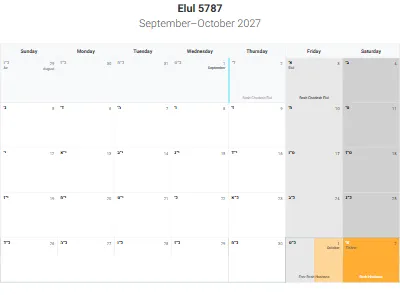
Late August into September (this year 3/9/27-1/10/27). Elul 5787 is the month that ends on the eve of Rosh Hashanah, so it sits across the end of the summer: the grid above gives the exact civil dates.
When does Elul start?
On the 1st of Elul, the second day of Rosh Chodesh (2-3/9/27). The civil date shifts every year, because the Hebrew year is about eleven days shorter than the civil one.
How many days are in Elul?
Twenty-nine, always. Elul is one of the fixed-length months of the Hebrew calendar: it does not vary between a full and a deficient year, and it is never doubled in a leap year.
When does Elul end?
On the 29th of Elul (1/10/27), the eve of Rosh Hashanah. The next day is the 1st of Tishrei and a new Hebrew year. Elul is also the only month of the year with no festival and no fast in it.
A Hebrew calendar for the month of Elul
The grid at the top of this page shows Elul as the Hebrew calendar sees it: the large numerals are the days of the Hebrew month, with the corresponding civil date printed beneath each one. You can see the two days of Rosh Chodesh Elul at the start, the Sabbaths and Torah portions read during the month, and the 29th of Elul closing it on the eve of Rosh Hashanah.
The button above the grid prints it to a single page, portrait or landscape, without the navigation or this text.
- Every festival and fast of the year in one table: Jewish holidays 2026
- The full printable calendar: printable 2026 Jewish calendar with holidays
- For a civil-month view, in which August and September appear separately: Gregorian month calendar
Related pages
References
- Pirkei DeRabbi Eliezer פרק מ״ו
And on the New Moon of Elul the Holy One, blessed be He, said to him: “Come up to me on the mount”, and let them sound the shofar throughout the camp, for, behold, Moses has ascended the mount, so that they do not go astray again after the worship of idols... Therefore the sages instituted that the shofar should be sounded on the New Moon of Elul every year.
source - Tur, Orach Chayim סימן תקפ״א, פתיחת הסימן
Therefore the sages ordained that the shofar be sounded on Rosh Chodesh Elul every year and throughout the month, to warn Israel to repent — as it is said, “Shall a shofar be sounded in a city” — and to confound the Satan.
source - Song of Songs פרק ו', פסוק ג'
I am my beloved’s and my beloved is mine; he browses among the lilies.
source - Mishnah Berurah סימן תקפ״א, ד״ה נוהגים לקום באשמורת
And there is a scriptural support: “I am my beloved’s and my beloved is mine” — its initial letters spell Elul, and its final letters total forty, corresponding to the forty days from Rosh Chodesh Elul to Yom Kippur; for during these forty days repentance is accepted, since one’s heart is near to his Beloved in repentance, and then his Beloved is near to him to accept his repentance in love.
source - Deuteronomy פרק ל', פסוק ו'
Then the Lord your God will circumcise your heart and the heart of your offspring, to love the Lord your God with all your heart and soul, in order that you may live.
source - Shulchan Arukh, Orach Chayim סימן תקפ״א, סעיף א
It is the custom to rise before dawn to recite Selichot and supplications from Rosh Chodesh Elul onward until Yom Kippur.
source - Rema on Shulchan Arukh, Orach Chayim סימן תקפ״א, סעיף א (הגה)
The custom of Ashkenazi communities is not so; rather, from Rosh Chodesh onward they begin to sound the shofar after the morning prayer... and they rise before dawn to say Selichot on the Sunday before Rosh Hashanah, and if Rosh Hashanah falls on Monday or Tuesday they begin from the Sunday of the week before.
source - Mishnah Berurah סימן תקפ״א, ס״ק ו
A further reason they fixed four days: we find that sacrifices require four days of inspection for blemishes before being offered... and therefore they fixed four days in which to inspect all the blemishes of one’s sin and repent of them.
source - Psalms פרק כ״ז, פסוק א
Of David. The Lord is my light and my salvation — whom shall I fear? The Lord is the stronghold of my life — of whom shall I be afraid?
source - Shulchan Arukh, Orach Chayim סימן תקפ״א, סעיף ג
Tachanun is not said in the prayers on the eve of Rosh Hashanah, even though it is said before dawn during Selichot; and the shofar is not blown on the eve of Rosh Hashanah.
source - Mishnah Berurah סימן תקפ״א, ס״ק כד
“And the shofar is not blown, etc.” — in order to separate the optional blasts from the obligatory ones.
source - Shulchan Arukh, Orach Chayim סימן תקפ״א, סעיף ב
It is the custom to fast on the eve of Rosh Hashanah.
source - Shulchan Arukh, Orach Chayim (with Rema's gloss) סימן תקפ״א, סעיף ד (הרישא — שו״ע; ההליכה לקברות — הגה)
One launders and cuts one’s hair on the eve of Rosh Hashanah... and there are places where the custom is to go to the graves and pray at length there, and to give charity there to the poor.
source - Likutei Moharan, Rabbi Nachman of Breslov חלק א', סימן רפ״ב
Know that one must judge every person favourably. Even someone who is completely wicked — one must search and find in him some modicum of good, for in that little bit he is not wicked... Likewise, a person must find this within himself... he must search until he finds in himself some little bit of good, for how is it possible that throughout his life he never once did some mitzvah or good deed.
source - Likkutei Torah, Rabbi Shneur Zalman of Liadi פרשת ראה, ד״ה 'אני לדודי ודודי לי' (דף לב ע״ב)
A parable of a king who, before he enters the city, is met by the people of the city in the field; and there anyone who wishes may go out to greet him. He receives them all graciously and shows a smiling face to all.
- Tur, Orach Chayim, citing Midrash Rabbi Tanchuma סימן תקפ״א, ד״ה נוהגין באשכנז להתענות
A parable of a province that owed the king taxes and did not pay; he came against it with an army to collect. When he was ten leagues off, the notables of the province went out to meet him... and he remitted a third. When he drew nearer, the middling townspeople went out to meet him, and he remitted a second third. When he drew nearer still, all the people of the city went out to meet him, and he remitted the whole.
source